Nvidia GTC Berlin: Jensen Huang Pulls Europe Into the AI Economy
Nvidia commits nearly 10 billion dollars to Europe's AI ecosystem, launches DSX POD modular AI factories and OpenShell agent safety at GTC Berlin on October 21, 2026.
On October 21, 2026, Nvidia CEO Jensen Huang delivered the keynote at GTC Berlin in front of roughly 3,000 developers, analysts and journalists at the Tempodrom auditorium in Berlin. He announced nearly 10 billion dollars in investment across Europe's technology ecosystem, a new modular AI factory design, and a safety system to keep AI agents under control. His central message was clear: Europe needs to produce AI, not just consume it.
1. Europe lags in AI computing capacity
Huang gave a number that shows the scale of the problem. Europe has only about 5% of the world's AI computing capacity, compared to 75% in the United States. The lack of massive computing power, or "compute" in technical terms, is a key obstacle for European developers who want to train their own AI models.
Jeannette zu Furstenberg, president and managing director of General Catalyst, a firm that invests in AI companies, summed it up before the speech: "The big bottleneck is compute."
Huang described AI as a "five-layer cake": energy powers advanced computers, computers form an AI factory, the factory generates tokens and digital intelligence from models, and that intelligence gets integrated into every application. He said infrastructure must exist before AI models emerge, just as the internet first needed networking and electricity first required the grid.
2. DSX POD: AI factories in containers
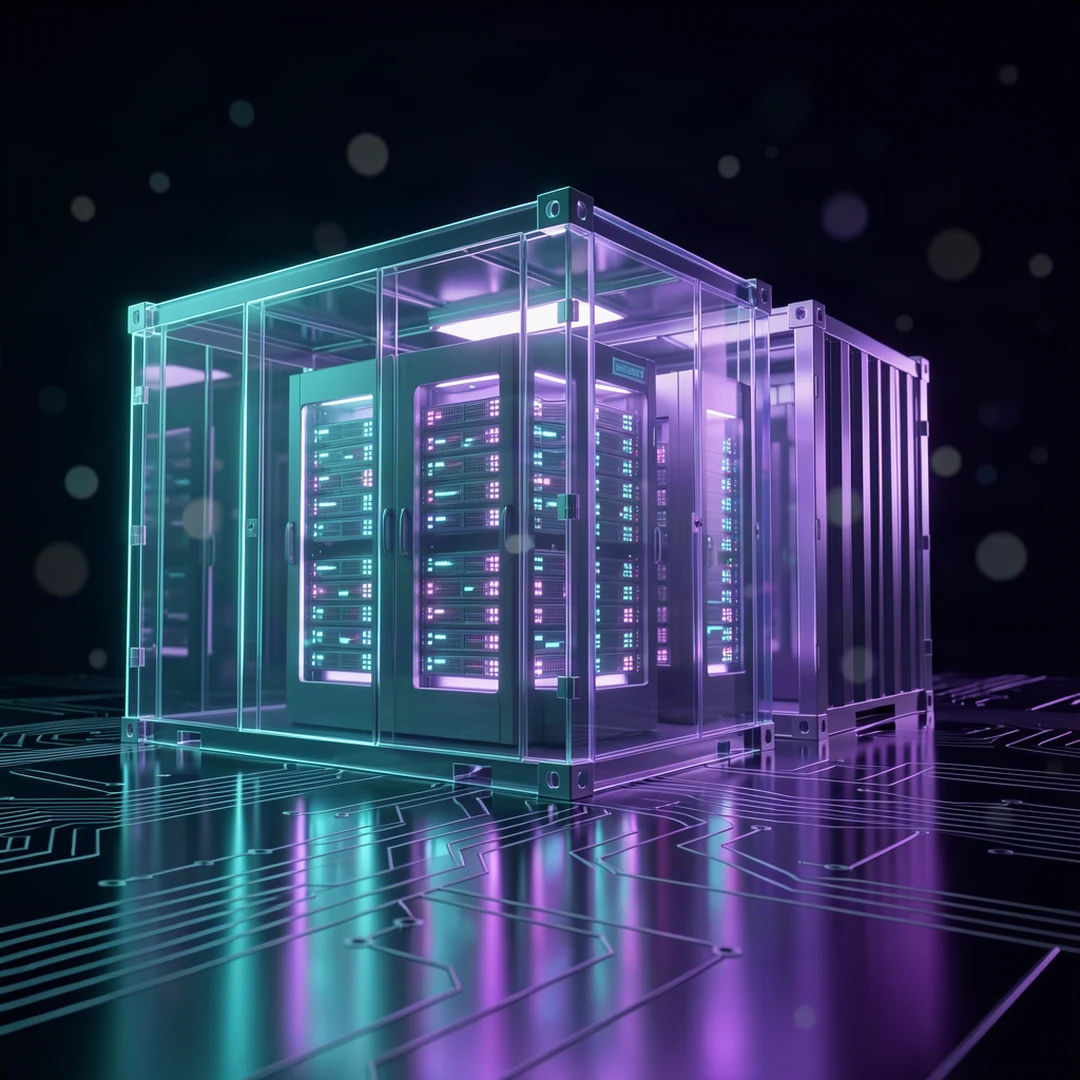
The headline announcement at GTC Berlin was Nvidia DSX POD, a reference design for complete Vera Rubin AI factories built by partners inside modular containers. Each unit is integrated and validated at the factory before being shipped to the customer site.
Nvidia said DSX POD cuts on-site deployment time at a prepared location from six months to as little as 14 days, once power, cooling and networking are ready. This means customers can start generating tokens and earning revenue sooner.
"An AI factory creates value when it starts producing tokens, not when construction is complete," Huang said in the official press release. Global partners including Dell Technologies, HPE, Lenovo, Schneider Electric and Vertiv will deliver DSX POD units worldwide in early 2027.
The broader DSX platform also claims to reduce water consumption for cooling by up to 100% and produce the same AI output with up to 30% less power.
3. OpenShell: Containing rogue AI agents
Huang acknowledged that AI agent safety is an engineering problem. Autonomous agents can access files, resources, networks and tools, so their privileges should be minimal and monitored.
Nvidia's answer is OpenShell, a new reference architecture for safe AI agents. It is open source software that creates a sandbox between the agent and the systems it can affect. The software enforces policy at the kernel level and checks restrictions before and during task execution.
OpenShell is combined with Nvidia Sentry, a monitoring system that runs on separate BlueField-4 data processing units. Nvidia said Sentry can quarantine agents that attempt to move outside their boundaries in milliseconds. Over 100 companies have backed the platform, including Anthropic, Microsoft, Arm and SpaceX.
4. Europe as an AI producer, not a consumer
Huang stressed that Europe should not depend on imported AI. "To be part of this AI economy, you don't want to just be consuming the AI; you want to be producing the AI," he said. "We could do all of that here in Europe, and in fact, we've already started."
He named nine European companies working with Nvidia on AI: L'Oreal, Revolut, Spotify, Merck, Vodafone, Zara, Porsche, Nestle and HSBC. Nvidia also works with 12,000 partners across Europe.
German Chancellor Friedrich Merz joined Huang at Kraftwerk, a former power station in Berlin, to discuss Germany's AI roadmap and the industrial applications of AI.
5. Physical AI and manufacturing partners
Huang said Europe's engineering expertise in mechatronics, electronics and mechanical systems gives it an edge in physical AI and robotics. "No region has dedicated itself to making mechatronics, electronics and mechanical systems at the level of precision and craft as the European region," he said.
Among the partnerships announced, Germany's Agile Robots plans to produce 1,000 to 2,000 petite humanoid robots next year in collaboration with Nvidia. Production is due to begin late this year.
In an on-stage demonstration, Huang shared the stage with tiny duck-shaped robots called "Microducks", 25 cm tall, developed by French startup Pollen Robotics in collaboration with Hugging Face. Three of the robots promptly fell over when Huang told them to take a nap, while the fourth needed extra persuasion.
What it means for you
GTC Berlin showed that AI is no longer just software in the cloud. It is becoming physical infrastructure: factories, containers, chips and robots. For readers in Malaysia and ASEAN, this development carries several practical signals:
- AI capacity shapes digital sovereignty: Europe is scrambling to catch up from its 5% share of global AI capacity. ASEAN nations should ask the same question: who builds our AI infrastructure, and where is data trained?
- Modular AI factories can deploy faster: DSX POD cuts installation from six months to 14 days. This could change how countries and companies build AI capacity without constructing giant data centers from scratch.
- Agent safety is becoming a requirement: OpenShell shows the industry now takes seriously the risk of AI agents going out of control. If your company starts using autonomous agents, make sure there are control and monitoring mechanisms in place.
- Physical robotics is getting closer: Commercial humanoid production begins in late 2026. Manufacturing companies should start thinking about how physical AI will change their operations in the coming years.
- New models and tools are arriving: Nvidia also announced open models including Nemotron, Cosmos, GR00T for robotics, and Alpamayo for autonomous vehicles. This means more AI tools accessible without depending on a single provider.
Sources
- GTC Berlin 2026: Live Updates From NVIDIA CEO Jensen Huang's Keynote (NVIDIA Blog)
- Nvidia CEO encourages Europe's lagging AI sector and offers tools to accelerate data center buildout (AP News)
- Nvidia's Huang hails Europe's AI potential, flanked by robot ducks (Reuters)
- NVIDIA Introduces DSX POD AI Factories to Accelerate Europe's Infrastructure Deployment (NVIDIA Newsroom)