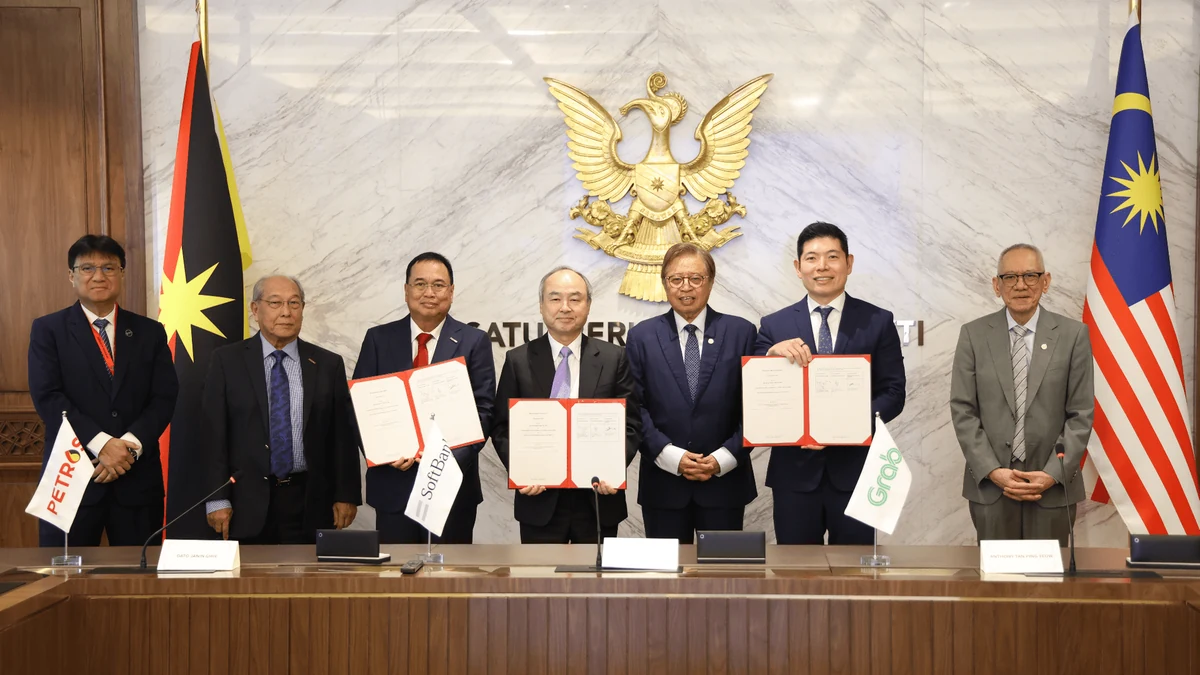
SoftBank, Grab and PETROS to build US$1.85 billion AI infrastructure in Malaysia
The three companies signed joint development agreements to build AI compute capacity in Sarawak and Peninsular Malaysia, with a long-term target of five gigawatts.
Malaysia just added another major AI investment announcement. On 9 November 2026, SoftBank Group, Grab and Petroleum Sarawak Berhad (PETROS) announced they had signed joint development agreements to build AI infrastructure in Sarawak and Peninsular Malaysia. The combined initial seed capital is US$1.85 billion, roughly RM7.5 billion. This is not a quick build: it is part of a multi-year plan targeting five gigawatts or more of AI compute capacity.
1. Who pays what
The initial money splits into two projects. For the Sarawak project, the proposed initial investment is US$1 billion: US$800 million from SoftBank Group, US$100 million from Grab and US$100 million from PETROS. SoftBank stays the majority shareholder, although Grab holds an option to increase its stake.
For the Peninsular Malaysia project, the proposed initial seed capital is US$850 million: US$650 million from Grab and US$200 million from SoftBank. Grab is the founding shareholder and will lead the project's development.
Totals across both projects: US$1 billion from SoftBank, US$750 million from Grab and US$100 million from PETROS.
2. The money is not spent yet
The agreements state the investment is deployed in stages, subject to development milestones, customer contracts and other closing conditions. The three parties will also seek additional investors and hyperscaler customers to support development and expansion.
Further development of the Peninsular project is expected to be financed at the project level through third-party equity and non-recourse project financing, meaning loans repaid primarily from the project's own cash flows.
The joint development agreements contain binding development and funding obligations, but the formation of the joint venture entities and each party's investment terms remain subject to definitive agreements. In other words, what was announced is a starting point, not money already spent.
3. Why Malaysia
According to research by Google, Temasek and Bain & Company in the e-Conomy SEA 2026 report cited in the press release, per capita AI usage across Southeast Asia's six largest economies is currently about one-tenth of the level in the United States, and regional AI usage is projected to scale by up to 60-fold by 2030. Demand on that scale requires compute infrastructure built in the region.
The facilities are expected to provide computing capacity to governments, multinational companies and small businesses, while supporting the development of locally tailored AI applications. The projects align with the National AI Action Plan 2026 to 2030, AI Nation 2030.
Malaysia is already a key data center destination in Southeast Asia. MarketWatch reported that relatively low electricity costs and abundant land are among the reasons, and Prime Minister Anwar Ibrahim has previously said Masayoshi Son plans US$50 billion of technology-related investment in the country.
4. Who runs it
Anthony Tan, Grab's co-founder and Chief Executive, is expected to oversee both projects while continuing to lead Grab, with dedicated management teams handling day-to-day operations. The Grab Board has approved his involvement.
SoftBank has also agreed in principle to a five-year lock-up on Grab shares held directly by an entity within its group.
Beyond infrastructure, the parties will explore areas of mutual interest including advanced manufacturing in Malaysia, with expected jobs in engineering, design and technical fields.
5. The green messaging behind the project
The press release states the facilities will operate in line with Malaysia's renewable energy use guidelines, with high-efficiency infrastructure designed to reduce water use and reliance on local power grids. This matters because AI data centers are famously hungry for both electricity and water, and every major announcement is now judged on its impact to the national grid.
What it means for you
This announcement strengthens Malaysia's position as Southeast Asia's AI infrastructure hub, but it is an early-stage agreement that depends on staged milestones.
- Technical jobs are coming. Facilities on this scale need local engineers, technicians and maintenance staff. If you work in electrical, cooling or data center operations, start watching related tenders and training programmes.
- Do not expect instant results. The investment is staged and still conditional. Of the US$1.85 billion announced, none is guaranteed to become a finished build.
- Five gigawatts is a long-term target. Actual capacity will rise step by step, tied to power supply and customer contracts.
- The region is building its own capacity. A projected 60-fold increase in Southeast Asian AI usage by 2030 makes local infrastructure a necessity, not an option.
Sources
- SoftBank Group and Grab Sign Joint Development Agreements to Develop AI Infrastructure in Malaysia (SoftBank Group)
- SoftBank, Grab and Petros to build 'among Asia's largest' AI facilities in Malaysia with US$1.85b seed capital (Malay Mail/Bernama)
- SoftBank, Grab, Petros to Invest $1.85 Bln for Malaysia AI Infrastructure (MarketWatch/Dow Jones Newswires)
- SoftBank and Grab plan US$1.85 billion investment in Malaysian AI infrastructure (Proactive via Yahoo Finance)