Anthropic researcher claims Claude helped prove the Riemann Hypothesis, a 167-year-old problem
Anthropic mathematician Levent Alpöge says he and Claude found a proof of the Riemann Hypothesis, but the Lean-based proof has not yet been checked by outside experts.
The most famous problem in mathematics may have just fallen, with AI as part of the story. On November 20, 2026, Levent Alpöge, a mathematician who works at Anthropic, announced that he had proved the Riemann Hypothesis with help from the company's Claude model. The claim has not been verified by anyone outside, so the 167-year-old problem officially remains open.
1. What is being claimed
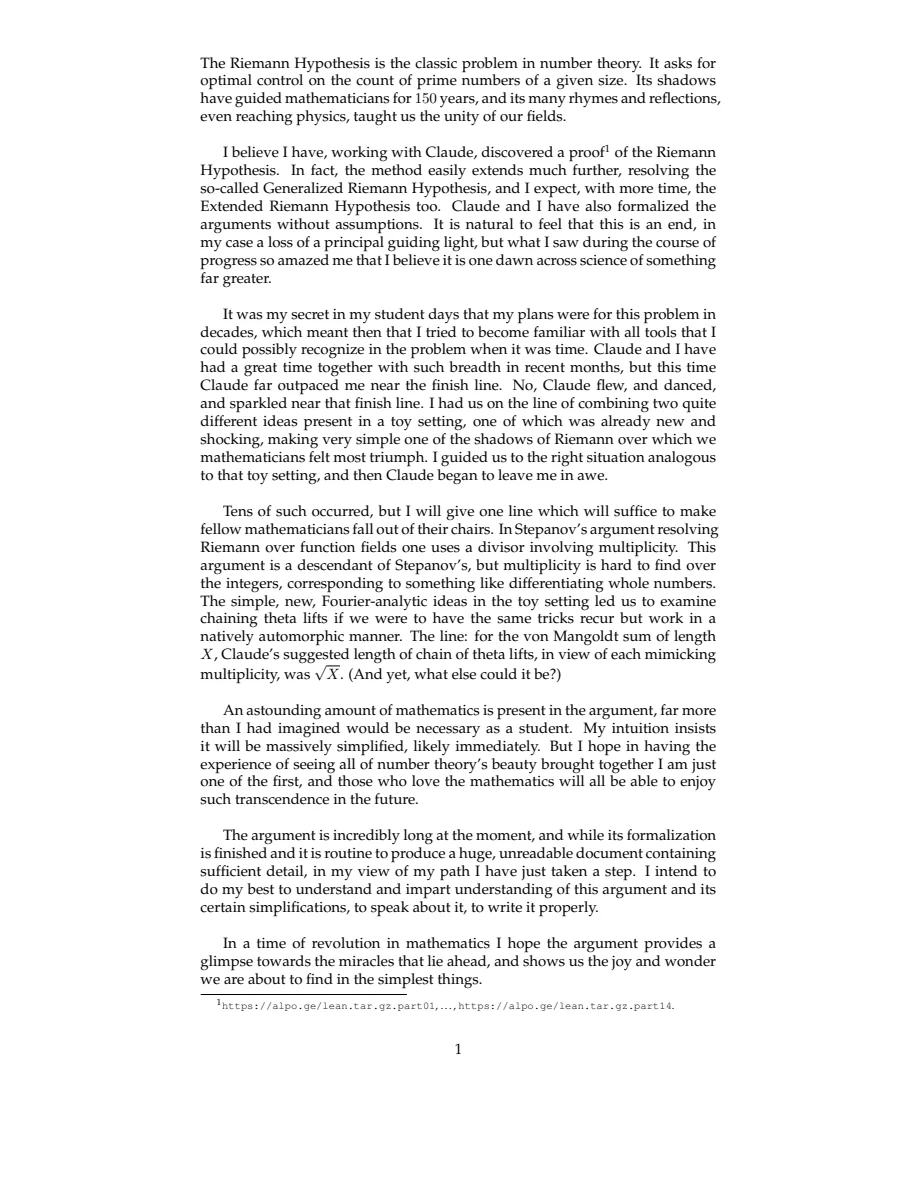
Alpöge posted a four-page note on his personal website, alpo.ge, on Friday. The opening line goes straight to the point: "I believe I have, working with Claude, discovered a proof of the Riemann Hypothesis."
He says the same method also settles a broader version, the Generalized Riemann Hypothesis, and that he expects the Extended Riemann Hypothesis to follow with more time. According to AFP, he consulted Anthropic CEO Dario Amodei before going public.
2. What the Riemann Hypothesis is
The Riemann Hypothesis was proposed by the German mathematician Bernhard Riemann in 1859. It concerns prime numbers, the numbers divisible only by 1 and themselves.
Primes look scattered randomly along the number line, but the hypothesis says their spread actually follows a precise, ordered pattern. It is widely regarded as the most important open question in pure mathematics, and it is one of the seven Millennium Prize Problems selected by the Clay Mathematics Institute in 2000.
There is a practical angle too: predictions about prime numbers underpin modern cryptography, including the systems protecting online payments. A full proof would give mathematicians optimal control over how primes are distributed.
3. A proof in computer code, not on paper
This proof was not published as a traditional paper. Alpöge released it as code in Lean, a programming language built to check mathematical arguments line by line with a computer.
According to the BBC, the full Lean proof runs to more than 250,000 lines. Alpöge himself said a fully written version would balloon to roughly 250,000 pages, and he admitted he has not yet mastered all the mathematics involved. He plans to write it up properly later.
Lean code makes checking easier in principle, but experts still need to confirm the code actually states the original hypothesis with no hidden assumptions. According to Interesting Engineering, the code archive holds about 239 megabytes across 175,187 files.
4. Top mathematicians say hold your horses
Terence Tao said on Friday that verification is still a long way off. "I imagine the digestion process will take some time, though in this case at least we have a human author to communicate with to assist with this task," he told the BBC.
Fields Medal winner James Maynard of the University of Oxford echoed the caution. According to the journal Nature, he said that if it fully checks out it would clearly be a historic milestone in mathematics, but added that for now the proof appears "crazily complicated" in its Lean code form.
The prize money also cannot be claimed overnight. According to The Verge, the Clay Mathematics Institute requires a solution to be published in a peer-reviewed journal and survive at least two years of scrutiny before it can be considered for the 1 million dollar prize.
5. Context: striking timing and a huge year for AI in math
The claim landed one day after Anthropic's record IPO on Nasdaq on November 19. Alpöge himself called the timing "horrible" and denied any promotional intent: "There is an obvious cynical view, to do with the timing, but it is false," he told the BBC.
According to Scientific American, he spent about six weeks building the proof with an unreleased version of Claude. Anthropic, for its part, has issued no statement of its own. The company's official site does record earlier steps: on August 10, 2026, Anthropic said a research version of Claude raised a longstanding lower bound on zeta zeros from 41.6% to 67.2%, while stressing this was not a proof of the full hypothesis, and that "we don't expect that the techniques Claude used will lead to proving the Riemann hypothesis."
Rival OpenAI has been in the same arena. In September, OpenAI said employees solved part of the Navier-Stokes equations, another Millennium Prize Problem, in an 88-hour run using more than 10,000 AI agents, according to the BBC. That proof also awaits full verification.
6. Now the ball is in the reviewers' court
This announcement is unusually easy to test because the proof exists as runnable code. Experts can try to compile the Lean files, check what is actually being proved, and hunt for any unsupported assumptions.
Brian Conrey, a leading Riemann hypothesis specialist interviewed by AFP, called it "a monumental moment in human history" and "really the biggest thing I think that's ever happened in mathematics" if it holds. He added that he believes "there will be simpler ways to do it".
As of today, no outside party has confirmed the claim. The Riemann Hypothesis officially remains open. What is certain: it has now become the sharpest test yet of AI's role in formal mathematics.
What it means for you
Most of us will never touch a zeta function, but this news still matters for anyone tracking where AI is heading.
- It is not official. The claim comes from one employee via a personal website, not an Anthropic press release. Treat it as a claim, not a fact.
- Wait for code verification. The Lean proof can be checked by machine, so verification should be faster than with a paper proof. Give independent experts time.
- AI techniques are now challenging century-old problems. Models have been scoring hard math wins all through 2026, and now they have reached the top of the list. That is a clear signal about where these tools are going.
- Do not swallow the sensational headlines. If you see "AI solves 167-year-old problem" stated as fact, remember that Tao, Maynard and the prize institute itself are all still waiting.
Sources
- In a year of AI solving maths problems, Anthropic may have just solved the biggest (BBC)
- Anthropic mathematician claims to have solved prestigious Millennium Prize problem with Claude (The Verge)
- Anthropic researcher says he and Claude proved the Riemann hypothesis, first posed in 1859 (AFP via Phys.org)
- Anthropic researcher says Claude solved math's greatest riddle (AFP via CP24)
- Learning more about Claude's mathematical capabilities (Anthropic, August 10, 2026)