OpenAI unveils MedChemBench, a new test of AI ability in medicinal chemistry
OpenAI introduced MedChemBench, a benchmark of 99 medicinal chemistry problems, and GPT-6.2 Astra earned 84.5% of the credit even though picking compounds remains far harder than reading molecular structures.
OpenAI introduced MedChemBench on November 20, 2026, a new benchmark that tests AI ability in medicinal chemistry, the field that searches for compounds that could become drugs. The benchmark is built from 99 problems taken from real research papers and patents. OpenAI itself cautions that a high score here does not mean a model can discover new medicines.
1. What MedChemBench tests
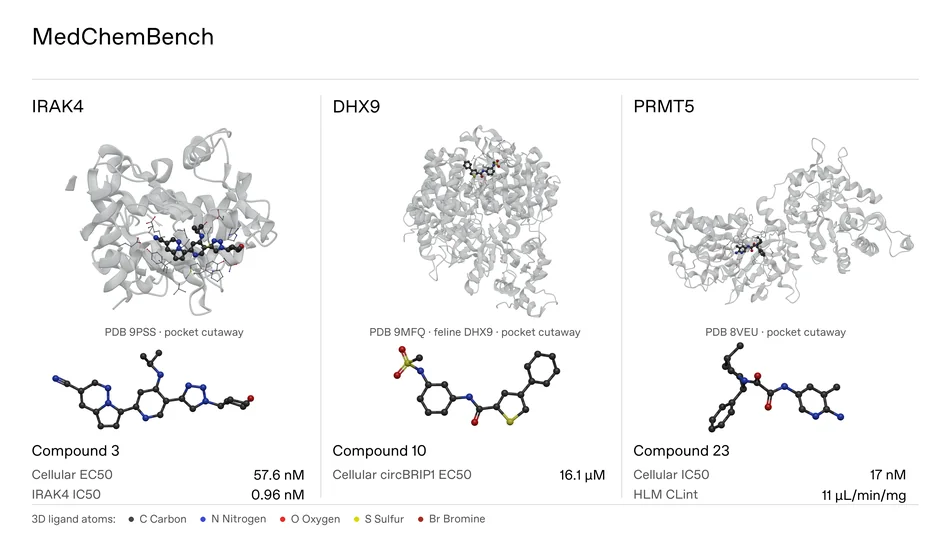
Each problem gives the model a real situation from drug research: the biological target, the researchers' goals, the compounds studied so far, and selected experimental findings. The model then has to complete a task such as choosing which compound to advance.
The benchmark grades four components: building molecular structures, scientific reasoning, ranking and selecting compounds, and predicting numerical properties. All of it spans 761 distinct molecular structures drawn from 117 papers and patents.
2. Where current models land
At the shared xhigh reasoning setting, GPT-6.2 Astra earned 84.5% of the available credit, according to OpenAI's announcement. GPT-6 Astra scored 83.3%, GPT-6.1 Sol 82.0% and GPT-5.6 Sol 58.2%.
One detail matters: GPT-6.2 Astra is not among the 11 models in the technical paper. That 84.5% figure comes from the announcement alone. The paper reports 60,390 graded responses across 11 GPT models, with the highest score of 83.8% reached by GPT-6 Astra at the max effort setting.
3. Reading structures is easy, picking compounds is hard
GPT-6 Astra earned 95.4% of the molecular structure credit at xhigh, but only about half the credit for compound selection and numerical property prediction, according to the technical paper. That gap is the benchmark's headline finding.
One example makes the gap concrete. On a problem that required keeping an 18-atom ring intact, GPT-6 Astra succeeded in all ten attempts. GPT-5.6 Sol and GPT-5.6 Luna failed all ten.
4. The PRMT5 example: two compounds, two tradeoffs
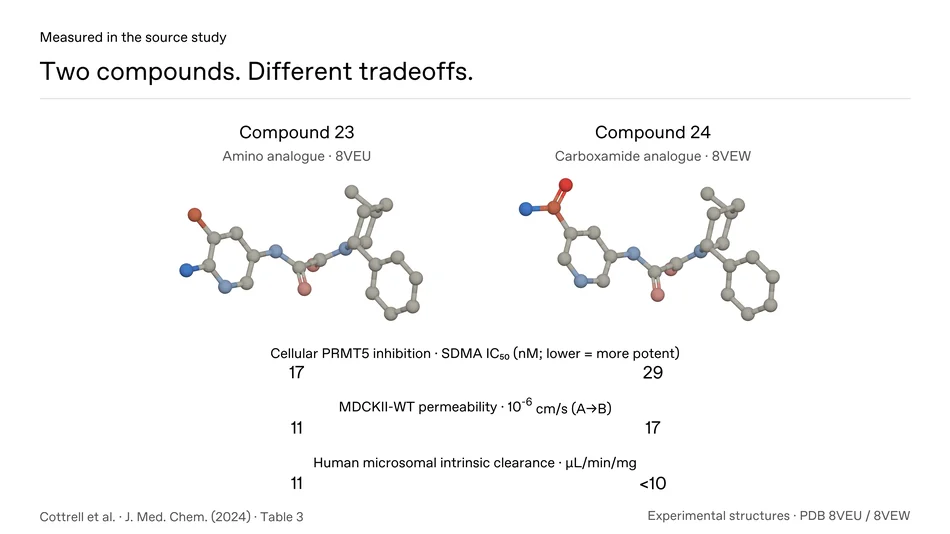
One problem involves PRMT5, a protein studied in cancer drug discovery. Models must reconstruct related compounds and predict cellular potency and clearance.
The source study's results show the classic medicinal chemistry tradeoff. Compound 23 was more potent in cells, while compound 24 crossed the cell barrier more readily and broke down more slowly in a liver enzyme assay, as summarized by Unite.AI.
5. The limits of this benchmark
OpenAI states plainly that these results do not show that models can discover drugs. The technical paper also lists limits: the problems are retrospective, the benchmark is close to saturation in its current form, and prior model exposure to the source papers cannot be ruled out.
Each answer was also a single attempt without outside tools such as calculators or structure checkers. The paper proposes extensions such as prospective cases and an agent-based track that could search for information, calculate properties and revise its answers.
What it means for you
MedChemBench is an early measurement for a big question: can AI help chemists pick promising compounds faster? The answer is getting closer, but it is not there yet.
- AI is moving into the lab. The latest models read molecular structures almost perfectly, work that takes humans months.
- Reading is not deciding. Compound selection scores are still around half, so final decisions stay with scientists.
- Check where a number comes from. Figures from an announcement and figures from the technical paper cannot always be merged.
- Follow AI tooling news. Open benchmarks like this often become industry standards. See AI Tools for tools you can already use today.