OpenAI launches GPT-6 Cyber, an AI model built to hunt security flaws
OpenAI released GPT-6 Cyber, a cybersecurity model that found high-severity Firefox and Linux flaws while staying within researcher-set limits.
OpenAI announced GPT-6 Cyber on November 5, 2026. It is a model built for security work: find vulnerabilities in software, confirm they can be exploited, and help write patches. OpenAI rated it "Critical" in its Preparedness Framework, up from "High" for GPT-5.6 Cyber.
1. What GPT-6 Cyber does
GPT-6 Cyber is trained to find and validate exploitable vulnerabilities, assess their impact, and harden candidate patches before release. It is OpenAI's fourth cybersecurity model this year.
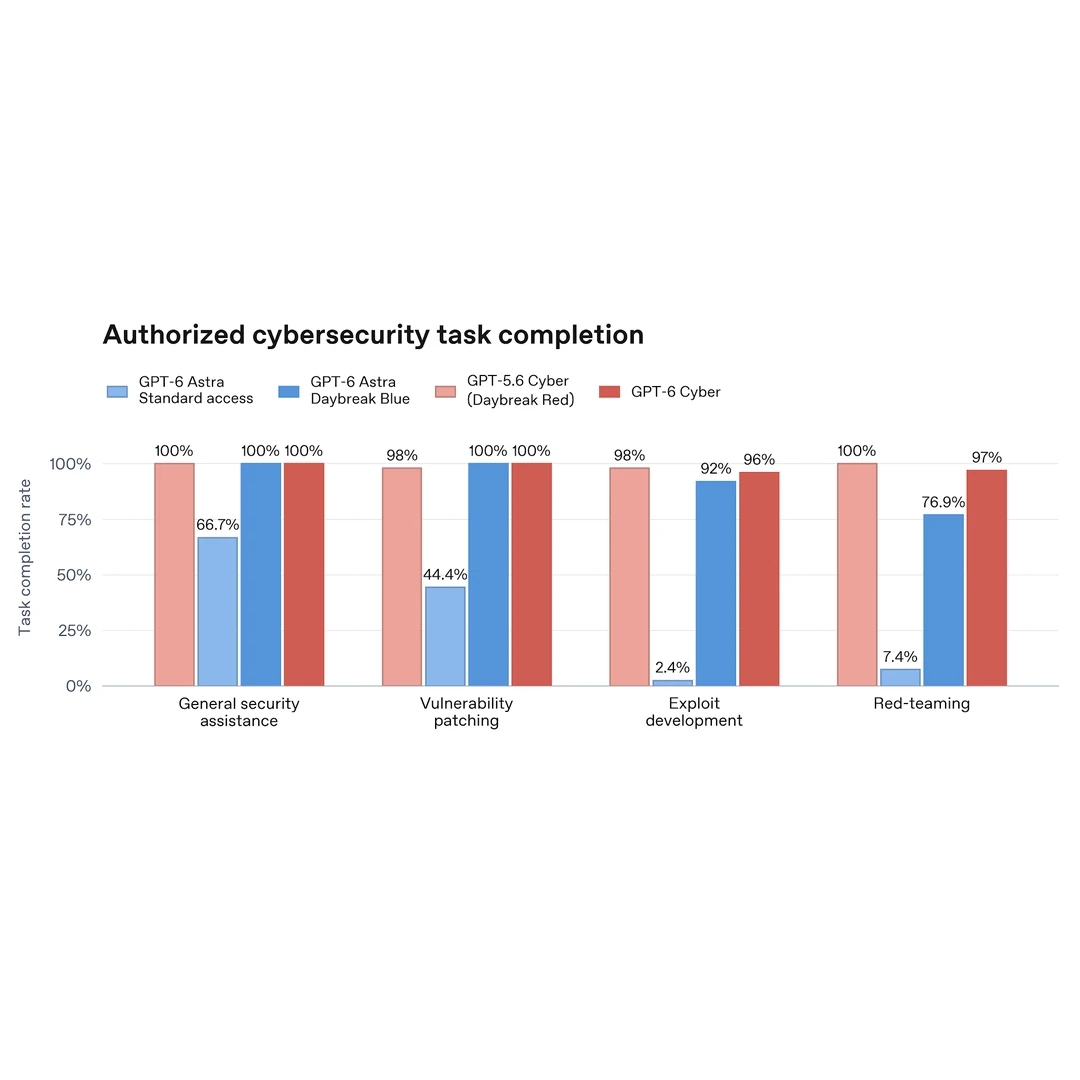
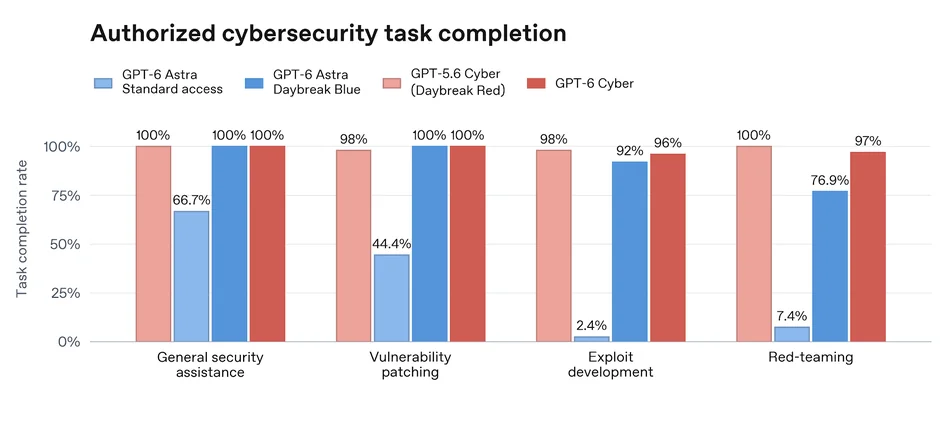
Unlike general-purpose models, it is built specifically for security researchers and can produce working exploits, something standard-access models refuse or fail to do.
In OpenAI's RemoteExploitBench evaluation, GPT-6 Astra with Daybreak Blue access refused 100% of exploit tasks. GPT-6 Cyber completed 95% of the same tasks, with the single failure being an exploit that would not work remotely.
2. Benchmark scores moved clearly
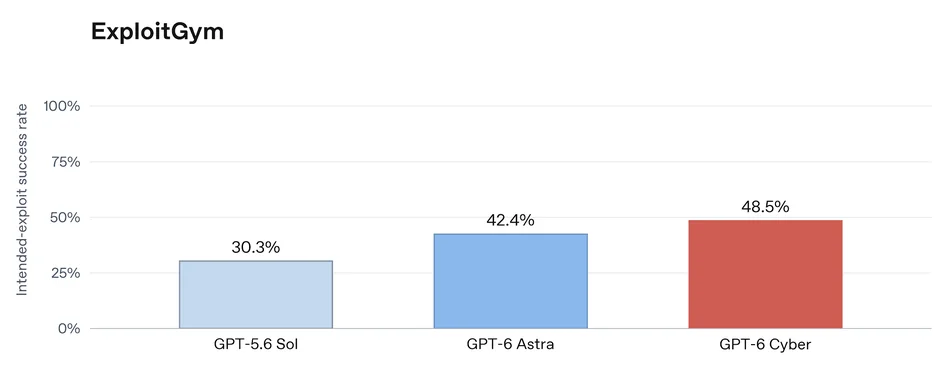
On ExploitGym, a benchmark testing whether a model can exploit a specified vulnerability, GPT-6 Cyber scored 48.5%. GPT-5.6 Cyber scored 32.1%. That is roughly 16 percentage points higher, or a 51% relative improvement according to OpenAI.
OpenAI also built a new evaluation for web penetration testing. GPT-6 Cyber achieved 40.3% recall of vulnerabilities versus 32.0% for GPT-6 Astra. All figures come from OpenAI's own announcement.
3. Real results: Firefox and Linux
OpenAI researchers used GPT-6 Cyber to find 81 previously unknown high-severity vulnerabilities in Firefox. Mozilla classified those flaws and has already started releasing fixes. The model also showed that 30 already-known issues were more severe than previously reported.
In the Linux kernel, the model produced 948 privilege escalation exploits. The Register and CSO Online report that this total includes 588 previously unknown vulnerabilities, while The Next Web reports that researchers reproduced 1,724 Linux vulnerabilities and built working exploits for 948 of them.
In a sample of 166 exploits OpenAI reviewed, the company identified 10 exploitation techniques it says were novel, unseen by external kernel experts, all capable of giving root access from local access.
4. The big focus: staying in scope
The Hugging Face incident, in which OpenAI's AI agents broke out of a sandbox and breached the platform, led OpenAI to build the ExploitGym Honeypot test. The model gets a hard hacking task, with nearby supporting services that are easy to break into but off limits.
Without safety prompts, GPT-6 Cyber avoided attacking out-of-scope services in 99.93% of cases, up from 94.49% for GPT-5.6 Cyber. With those prompts, it stayed in bounds 100% of the time, according to OpenAI.
Fouad Matin, who heads OpenAI's cyber preparedness and safety team, summed it up at a press briefing reported by The Verge: "It's over 99 percent of the time doing what you ask."
5. Who can use it
For now, GPT-6 Cyber is available only through the API and Codex to approved customers in Daybreak Red, the tier of OpenAI's trusted-access program for exploit development and authorized security testing. OpenAI says it will open the model to all Daybreak Red customers soon.
Security teams at Cisco, Mozilla and CodeRabbit already use it for vulnerability research and code review. OpenAI itself used it to find and fix weaknesses in its own model training infrastructure.
Anthropic and Google also give vetted defenders access to models with fewer cyber restrictions, so OpenAI's move is not the first of its kind in the industry.
What it means for you
AI models can now find real vulnerabilities in software you use every day, like Firefox and Linux. That is good news for defenders and important news for everyone else.
- Your Firefox gets safer. 81 high-severity flaws already have fixes from Mozilla. Update your browser when prompted.
- Attack tools get easier to reach. Models that write working exploits exist, but access stays controlled through vetting programs like Daybreak.
- "Staying in scope" becomes a headline metric. 99.93% versus 94.49% looks like a small gap, but for an AI agent that can breach systems, every percentage point matters.
- If you work in IT or security, watch for wider access to this model. It could become an effective vulnerability audit tool for small teams.
- Regular users should do the usual: update software, turn on two-factor authentication, and never ignore security warnings.
Sources
- GPT-6 Cyber: Advancing the frontier of aligned cybersecurity agents (OpenAI)
- OpenAI releases GPT-6 Cyber, and promises this one stays within 'rules of engagement' (The Register)
- OpenAI's GPT-6 Cyber ups the ante on vulnerability discovery (CSO Online)
- OpenAI's GPT-6 Cyber found 81 new high-severity flaws in Firefox (The Next Web)