NVIDIA launches GR00T 2, a robot model trained on 400,000 hours of human video
NVIDIA introduced GR00T 2 at CoRL, an open model that teaches robots fine hand skills from human video, and released 100,000 hours of that footage for free.
NVIDIA introduced GR00T 2, an open AI model for robots, at the Conference on Robot Learning (CoRL) in Austin, Texas on 9 November 2026. NVIDIA calls it a "world action model" because it first predicts how its actions will change what it sees, then moves. The announcement lands at an awkward moment for the company: two days after its board opened an independent investigation into CEO Jensen Huang.
1. What GR00T 2 can do
GR00T 2 is built on NVIDIA Cosmos and trained for fine manipulation: sorting packages, assembling small parts, connecting cables and handling soft objects. In NVIDIA's tests across 50 tasks the target robot had never seen, the model:
- completed 40 of those 50 tasks at least once with no task-specific demonstrations,
- averaged 71% success with one demonstration per task,
- reached 95% with five demonstrations, after a 30-minute fine-tune on a single RTX 5090.
NVIDIA's own research paper notes that the tasks were picked from a list the model could already learn well, so these numbers are not an average across all conceivable robot tasks. The Next Web highlighted the same caveat.
2. It learned from people, not just robots
The training data is the most interesting part. According to NVIDIA's research page, GR00T 2 was pretrained on a mixture of 402,730 hours of egocentric video of people at work, 10,184 hours of demonstrations with a handheld UMI gripper across 2,897 tasks, and 23,500 hours of robot teleoperation. Human video dwarfs the robot data.
Of that total, 100,000 hours of human footage are openly available as the Human-1M-100K dataset on Hugging Face, free for anyone to use in their own robot training. The model code is expected in December 2026, according to the same research page.
3. Skills transfer between robot bodies
NVIDIA shows what it calls X-Adaptability: skills demonstrated by humans or other tools carry over to robots that never practiced the task. Examples from the research page:
- a two-handed robot lines a chemistry-lab funnel with filter paper after watching only human demonstrations, succeeding in 65% of trials,
- the YAM arm assembles a toy dump truck end to end in 60% of trials after UMI-only demonstrations,
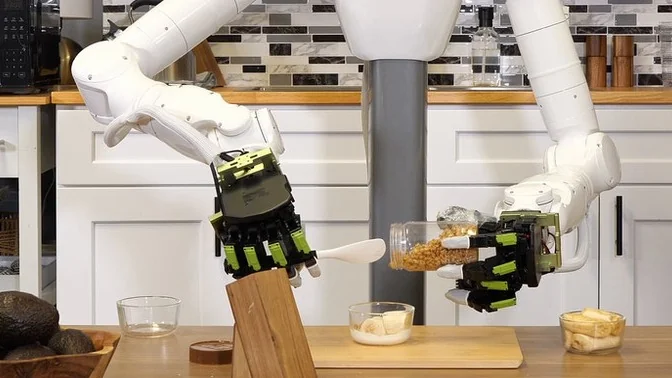
- a robot with two 22-degree-of-freedom hands scoops granola and stirs yogurt in a kitchen after demonstrations with the wearable DexUMI glove.
4. Big companies are already testing it
This is more than a lab demo. According to NVIDIA's blog, Foxconn is applying GR00T 2 to factory automation for server manufacturing, Siemens is evaluating it across industrial use cases, and Nexuni is testing it for laundry handling. Worth noting, as The Next Web points out, all three are still in testing and none has confirmed production use.
NVIDIA also claims the model ranks among the top three across the RoboCasa365, RoboLab, RoboDojo and MolmoSpaces benchmarks. That standing is NVIDIA's own claim, not an independently verified award.
5. The full package: Isaac Lab 3.0 and new benchmarks
NVIDIA also released Isaac Lab 3.0, its open-source framework for training robots in simulation. With the Newton physics engine, it achieved up to 2.5x the training throughput of Isaac Lab 2.3 with PhysX in one vision-based dexterous manipulation test, letting researchers train thousands of simulated robots in parallel.
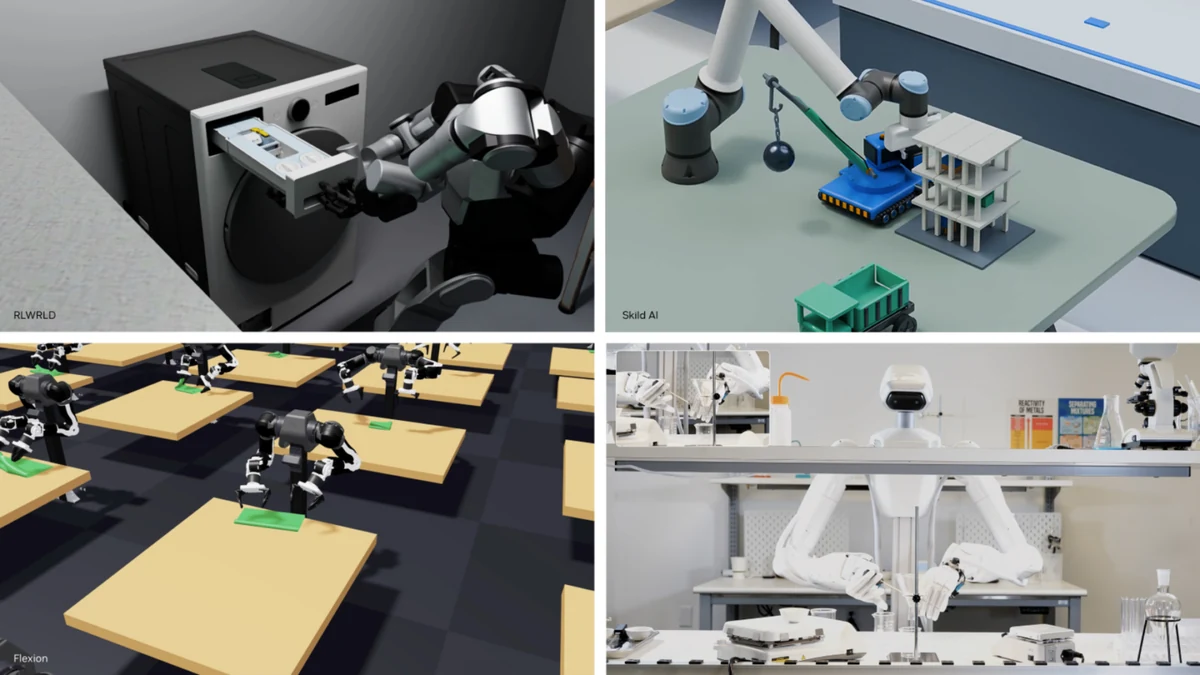
Two new open benchmarks arrived as well: DexBench, built with RLWRLD, with 15 tasks across retail, logistics, manufacturing and hospitality scenes, and VABAR from UC Berkeley with six industrial tasks. Both measure robot dexterity and adaptability across standardized variations.
What it means for you
Industrial robots are usually taught one task at a time, which is slow and expensive. GR00T 2 and the freely released human video point to a different direction for the industry: one foundation model shared across many robot bodies, with light fine-tuning for new tasks. For companies in Malaysia and elsewhere considering warehouse or factory automation, the base tools are now free to try, though the hardware and simulation expertise are still on you.
- Robots now learn like students. One demonstration got 71% success in NVIDIA's tests and five got 95% on the selected task list. That beats hand-programming every motion.
- Open data lowers the barrier. 100,000 hours of human video on Hugging Face means small labs and universities can build robot models without collecting their own data from scratch.
- The code is not out yet. Model code is expected in December 2026, so for now you can read the paper and watch demos, but not run the model.
- Test numbers are not factory guarantees. The tasks were chosen from ones the model could learn, and industrial partners are still evaluating. Treat this as early.
- No change for consumers today. But if robot foundation models follow the path of language models, the price of physical automation could fall over the next few years.
Sources
- Practice Makes Precise: At CoRL, NVIDIA and Partners Reveal How Robots Rehearse Delicate Work in Simulation (NVIDIA Blog)
- GR00T 2: Scaling Robot Foundation Models for Generalization, Dexterity, and Adaptation (NVIDIA Research)
- NVIDIA launches GR00T 2 and Isaac Lab 3.0 at CoRL (The Robot Report)
- Nvidia's GR00T 2 teaches robots delicate skills from human video (The Next Web)