Google launches Gemini Decisions API for fast yes-or-no answers
Google DeepMind released the new Gemini Decision 1 model and Decisions API that answer up to 1,000 closed-set questions in a single pass at 10 cents per million input tokens.
Google DeepMind released the Gemini Decisions API on November 11, 2026. It is powered by a new model called Gemini Decision 1. This is not a general chatbot. It is built for closed-set questions: yes or no checks, multiple choice, and rubric scoring.
1. What Google launched
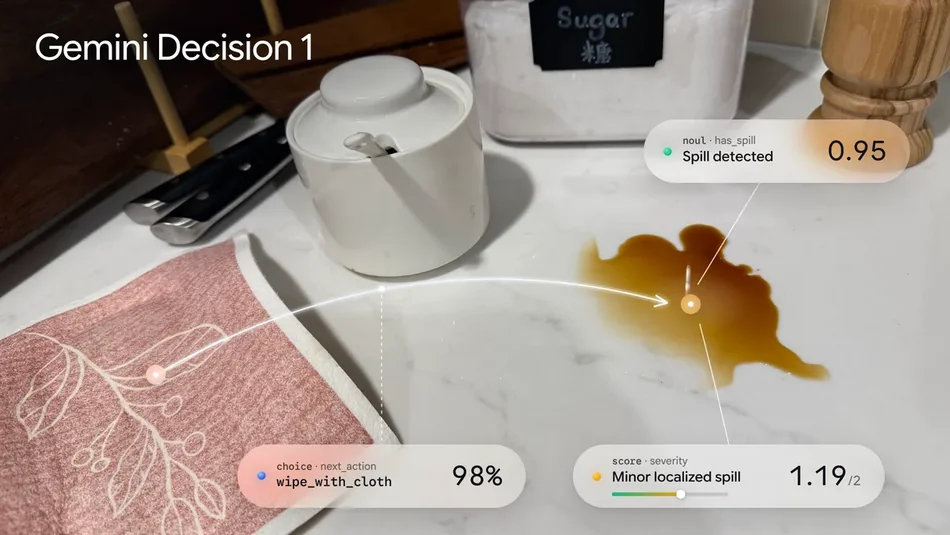
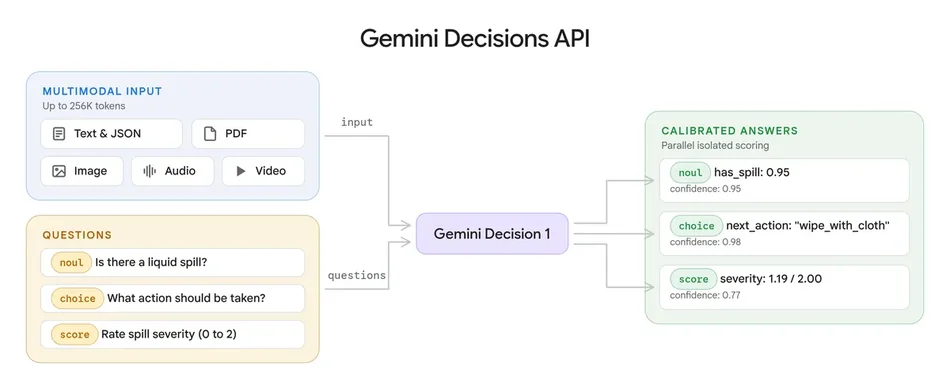
The Decisions API is a new endpoint in the Gemini API, available in Google AI Studio. You provide one input (text, images, audio, video, or PDFs, up to 256,000 tokens) along with up to 1,000 independent questions. The model scores everything in a single pass instead of generating answer text token by token like a regular LLM.
Three question types are supported. "noul" estimates the probability that a yes-or-no condition holds. "choice" picks between 2 and 255 options and returns the probability of each. "score" grades the input on an ordered rubric you define.
Every answer comes with a confidence score between 0 and 1. Your code can use that score to send ambiguous cases to a human reviewer or a second model.
2. Fast and cheap
Google says median latency is 50 to 100 milliseconds of model compute, or 150 to 250 milliseconds end to end, for inputs up to 16,000 tokens. Performance stays nearly flat from 1 to 100 questions per request.
Pricing is $0.10 per million input tokens, and output tokens are not billed. According to Google's blog, that is nearly 5x cheaper than Gemini 3.5 Flash-Lite with the Interactions API across a shared benchmark suite.
3. The decision model market is getting crowded
Google is not first. TypeSafe launched Jev in mid-September and gained a million users within days, then raised $870 million at a $7.5 billion valuation, according to SiliconANGLE. OpenAI has its Decisions API running on GPT-6 Luna. Amazon offers Strands Decider, which can run on your own infrastructure, according to VentureBeat.
4. Who wins the comparison
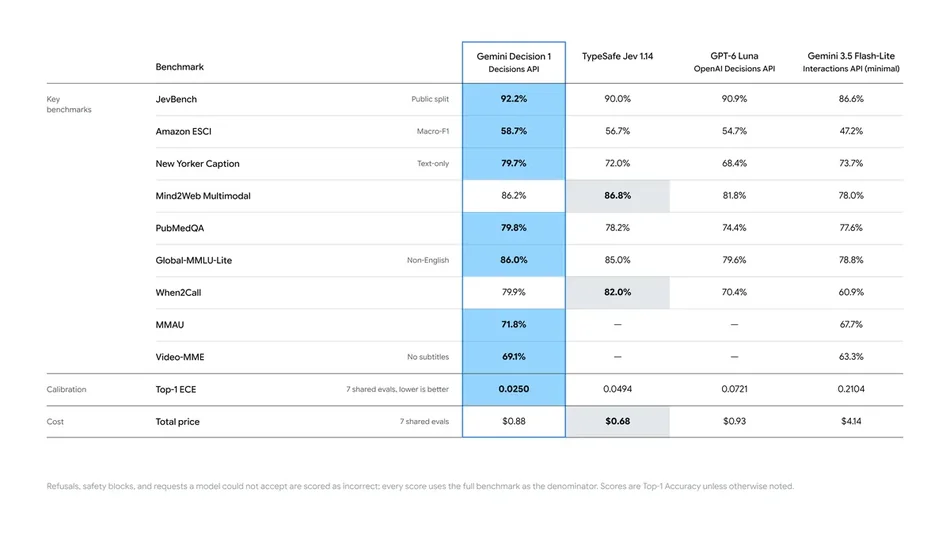
Google claims Gemini Decision 1 performed better on 7 of 9 benchmarks tested against Jev and OpenAI. But Jev remains cheaper: Simon Willison notes Jev costs 4.2 cents per million input tokens, versus 10 cents for Gemini and OpenAI.
Gemini's advantage is modality. Jev only accepts text and JSON. OpenAI accepts text and images. Gemini Decision 1 takes text, images, audio, video, and PDFs together in one request.
Read the numbers carefully: these benchmarks were published by Google itself, not by an independent party.
5. Real-world use cases
VentureBeat gives an insurance claims example. One request can carry a scanned form, photos of the damage, and notes from a customer call, then ask which queue the claim should go to, whether evidence is missing, and how urgently it needs review.
Google itself uses the model in Gemini Notebook to route queries to the right model and reasoning effort. The company reports up to 40% lower latency for routine queries in that workflow.
What it means for you
If you build apps with many small judgments, there is now a cheaper option than a full LLM call for each one. Confidence scores also make it easier to know when a human should step in.
- Audit your tasks. Checklists, content filtering, and ticket routing are the best fits for a decision model.
- Start on the free tier. Google AI Studio has a no-cost tier for prototyping before you pay.
- Compare modalities. If your data includes video or PDFs, Gemini differs from text-only Jev.
- Read the numbers yourself. The benchmark claims come from Google, so test with your own data before deciding.
- Plan a fallback path. Low confidence scores should route to a human or another model, not be accepted blindly.
Sources
- Gemini Decisions API: Fast, calibrated multimodal decisions (Google)
- Google's Gemini Decision 1 model scores up to 1,000 questions in one API call (VentureBeat)
- Google enters decision model market with Gemini Decisions API (SiliconANGLE)
- Gemini Decisions API (Simon Willison)