Google ships Gemini 4 Neon, its fourth model in a month
Google DeepMind launched Gemini 4 Neon, a mid-tier model between Carbon and Hydrogen priced at 3 dollars per million input tokens.
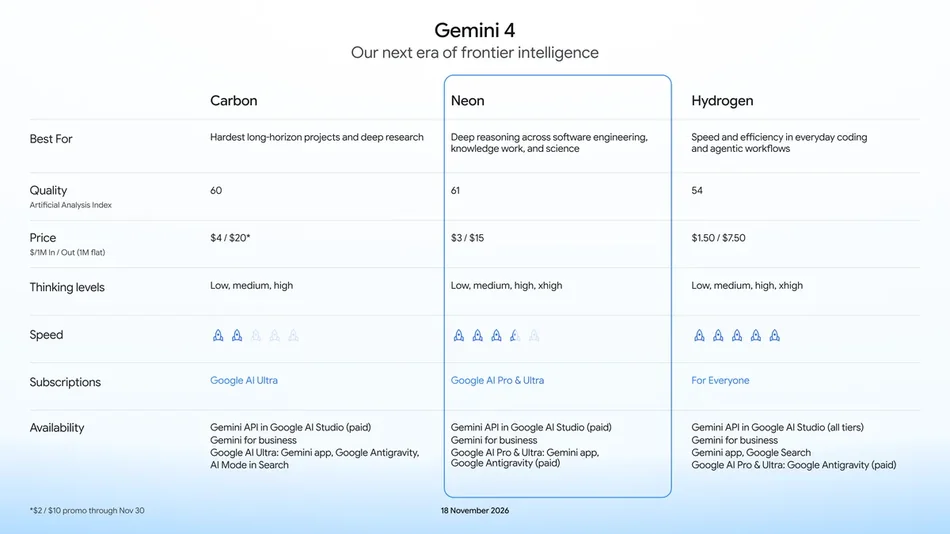
Google DeepMind announced Gemini 4 Neon on 18 November 2026. It is the fourth model in the Gemini 4 family within a single month, following Hydrogen, Argon and Carbon. Neon sits in the middle: deeper than Hydrogen for everyday work, faster and cheaper than Carbon for the hardest projects.
1. What Neon offers
Neon is built for complex, high-frequency work: software engineering, knowledge work, and science workflows. Google says it completes tasks end to end quickly without giving up reasoning depth.
The model takes in text, images, video, audio and PDFs in a single one-million-token context window, but it only outputs text. It supports computer use, code execution, file search and grounding through Google Search and Maps. Four thinking levels, from Low to Extra High, let you trade speed for reasoning depth.
2. How it scores in independent evaluations
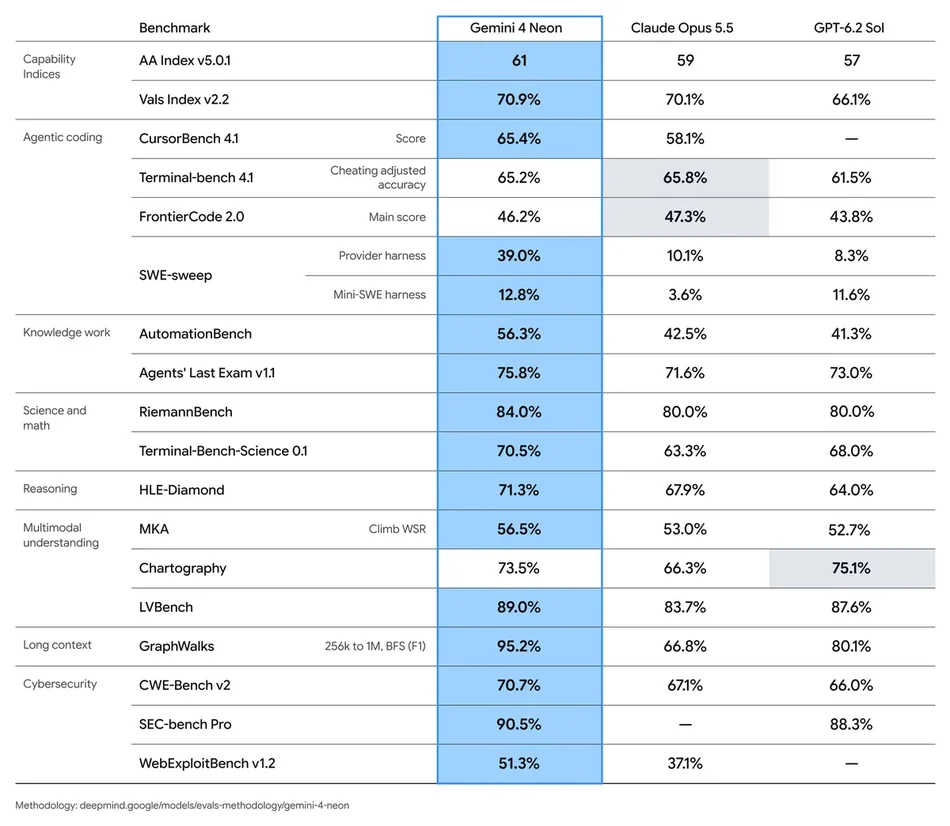
At its xhigh thinking level, Neon scores 61 and ranks third overall on the Artificial Analysis Intelligence Index, just behind larger, slower models. It ranks second on the Vals Index and second for steerability, meaning how cleanly it takes mid-task user corrections, on the new Agent Arena Index.
For technical work, Neon is first on the Artificial Analysis Coding Agent Index with a score of 58.6 and first on Zapier's AutomationBench at 56.3%. In internal Google Antigravity testing, Google recorded its lowest fabrication rate yet for one of its models.
3. Pricing and where it fits in the Gemini 4 family
The Neon API costs 3 dollars per million input tokens and 15 dollars per million output tokens, with cached input at 0.15 dollars per million tokens, a 95% discount. That is more expensive than Carbon and Argon, which are on a 2-dollar and 10-dollar promotional rate through 30 November before rising to 4 dollars and 20 dollars on 1 December. The Decoder lists the full comparison: Hydrogen at 1.50 and 7.50 dollars, Carbon and Argon at 2 and 10 dollars (promo), Neon at 3 and 15 dollars.
According to Google Antigravity, Neon at its default High thinking level costs 32% less per task than Carbon. Google also claims Neon's cost per task is 50 to 80% lower than top competing models, based on the Vals Index and Agent Arena.
4. Where you can use it
Neon started rolling out on 18 November in the Gemini API in Google AI Studio, in Gemini for business via the API and model dropdown, in Google Antigravity for paid Google AI Pro and Ultra subscribers, and in the Gemini app for Pro and Ultra subscribers.
In the Gemini app, Neon replaces Argon, and Gemini 3.1 Pro is being retired as well. The model picker now offers four choices: Auto, Hydrogen for everyday help, Neon for deeper analysis, and Carbon for code and complex work. A separate version, Gemini 4 Neon for cyber, is rolling out over the coming days to selected security defenders through the Fairwind Program.
5. Pairing Neon with Hydrogen in Orchestrator
The catch: not every step in a multi-step task needs top-level reasoning. In Google Antigravity, the Orchestrator feature can now pair Neon as the planner with Hydrogen as the executor in a single session.
Neon handles upfront planning, architecture and complex reasoning, then hands routine code edits, package updates and test runs to Hydrogen. When Hydrogen hits friction, it hands back to Neon to inspect state, repair the plan and resume execution. Google says this stretches your quota further on every run.
What it means for you
Google is now shipping new models almost weekly, and keeping up with the lineup is getting harder. The good news: the same capability now costs less, and the division of labor between models is becoming automatic.
- Paid Gemini users: Check the model dropdown in the Gemini app. If you are on Pro or Ultra, pick Neon for heavy analysis and writing; it replaces Argon.
- Developers: Compare your actual task costs. Neon is 3 dollars per million input tokens, but cached input at 0.15 dollars per million makes repetitive workflows far cheaper.
- Antigravity users: Try pairing Neon as planner and Hydrogen as executor in Orchestrator for multi-step tasks.
- Everyone else: Nothing extra to do. If you already use Auto in the Gemini app, the system picks the model for you.
- Watching the industry: Google's release cadence this month has outpaced OpenAI and Anthropic. It is real pricing pressure on every model provider.
Sources
- Introducing Gemini 4 Neon (Google)
- Gemini 4 Neon in Google Antigravity (Google Antigravity)
- Google launches Gemini 4 Neon with Carbon quality at Flash speeds, live for AI Pro (9to5Google)
- Google ships Gemini 4 Neon, its fourth new Gemini model in a month (The Decoder)