Google ships Gemini 4 Hydrogen, a fast model for everyday work
Google launched Gemini 4 Hydrogen on November 12, 2026, a fast model for coding and agent workflows that also upgrades Google Search.
Google released Gemini 4 Hydrogen on November 12, 2026. It is the Gemini 4 family member built for speed: writing code, running tests, and handling everyday agent work quickly. The frontier models Gemini 4 Carbon and Gemini 4 Argon stay reserved for harder problems that need long-horizon reasoning.
1. A daily-driver model for everyone
According to Google's official blog post, Hydrogen is built for rapid execution across agentic workflows, not deep reasoning like Carbon and Argon. The biggest difference is rollout reach. SiliconANGLE reports that Argon previously went through a limited testing phase with Google's Fairwind Program before opening to developers, while Hydrogen skipped that stage entirely and is available to everyone from day one, including free Gemini users.
Free users of the Gemini app get Hydrogen through automatic model selection when it is the right fit for a prompt. The model also lands in Google Search for all users.
2. Outscoring Argon on benchmarks
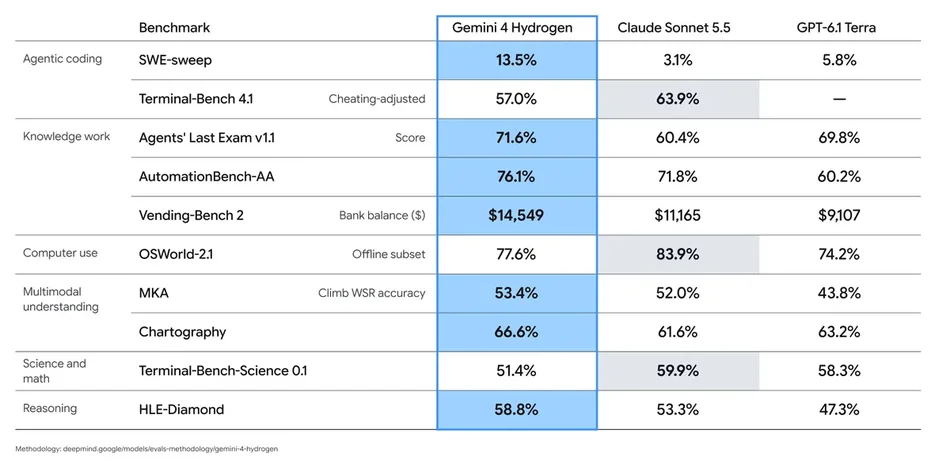
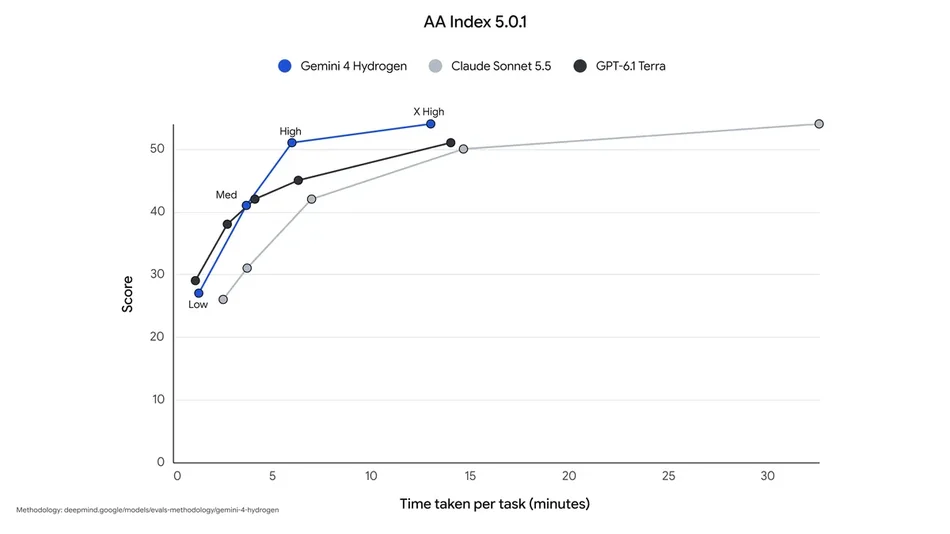
Google claims Hydrogen scores 51 on the Artificial Analysis Intelligence Index at its default "high" thinking level, versus 50 for Argon. At the new "xhigh" level, the score rises to 54. These are Google's own claims, as reported by SiliconANGLE and The Decoder.
Compared with Gemini 3.8 Flash, which launched in September, Google says Hydrogen finishes tasks 2.5x faster at the default setting, and its Terminal-Bench 4.1 score climbs from 18.2% to 57%. Google also claims fabricated claims drop more than 5x. All of these performance numbers come from Google's internal testing, so read them as vendor claims, not third-party results.
3. Flat pricing and four thinking levels
Hydrogen costs $1.50 per million input tokens and $7.50 per million output tokens, flat across the entire 1 million-token context window. For comparison, SiliconANGLE reports Argon costs $2 and $10 until its introductory pricing ends on November 30, then rises to $4 and $20.
Hydrogen offers four thinking levels: low, medium, high (default), and a new xhigh tier. You only pay for and wait for the reasoning depth a task actually needs.
4. Orchestrator in Google Antigravity
Alongside Hydrogen, Google introduced Orchestrator in Google Antigravity. According to the official Antigravity blog, Orchestrator switches models dynamically within a single session: Carbon plans and coordinates, Hydrogen writes edits, updates packages, and runs tests. If Hydrogen hits friction, it hands control back to Carbon.
Google claims Orchestrator reaches near-Carbon task success rates while using 24% less quota and finishing 19% faster. One caveat: the two Google posts name different Terminal-Bench versions for the same numbers, 4.0 in the model announcement and 4.1 in the Antigravity blog. In Antigravity, Hydrogen is available to Google AI Pro and Ultra subscribers, while Orchestrator is rolling out to Ultra subscribers first.
5. Google Search gets an upgrade too
Hydrogen now powers Google Search for all users globally. According to Google, Search better understands questions phrased as natural sentences, including multi-part queries and typos, delivers more visual responses, and expands its query fan-out technique to surface a wider range of links.
What it means for you
The Gemini 4 family is now complete barely six weeks after it started, three models shipped, and Hydrogen is the one you will use most often.
- Free Gemini users: you will feel the change automatically through model selection and Google Search, with nothing to set up.
- Developers: $1.50/$7.50 per million tokens is cheaper than Argon, so everyday coding and agent work is now cheaper on the Gemini API and AI Studio.
- AI Pro and Ultra subscribers: try Hydrogen in Antigravity and let Orchestrator pick between Carbon and Hydrogen for the best quality-per-token balance.
- Content workers: the 1 million-token context lets you turn dense PDFs, spreadsheets, and long recordings into one cited report in a single prompt.
- Search users: Google Search answers will look more visual and link to a broader range of sites starting this week.
Sources
- Introducing Gemini 4 Hydrogen (Google Blog)
- Gemini 4 Hydrogen and Orchestrator (Google Antigravity Blog)
- Google releases Gemini 4 Hydrogen, a lower-cost model said to outscore Argon (SiliconANGLE)
- Google announces Gemini 4 Hydrogen, rolling out to Gemini app (9to5Google)