Gemini 4 Carbon Tops MathArena, Google Now Has the Best Math Model
Google's Gemini 4 Carbon now leads the independent MathArena leaderboard, edging out OpenAI's GPT-6.1 Sol and Anthropic's Claude Fable 5.2, though each test run costs far more.
The MathArena leaderboard, an independent math benchmark run by an ETH Zurich researcher, has a new leader. On November 13, results for Google's Gemini 4 Carbon and Anthropic's Claude Fable 5.2 were added, and Carbon immediately took first place overall. It is the first time in a long while that a non-OpenAI model has held the top spot on MathArena.

1. The actual numbers
Gemini 4 Carbon, at its high reasoning setting, scored 85.4% expected performance with a 3.0 margin of error. Claude Fable 5.2, at max, reached 82.8% with a 5.3 margin. OpenAI's GPT-6.1 Sol, the previous leader, sits at 80.6% with a 2.7 margin.
These figures come straight from MathArena, not from Google. Google itself did not announce the ranking. Jasper Dekoninck of the MathArena team noted the change on November 13.
On the ArXivMath track for math papers, Carbon's overall average is 94.28% with a 3.64 margin, and its September 2026 run hit 96.23%.
2. A narrow lead
The error margins of all three models overlap. Carbon's range, 82.4% to 88.4%, touches both Fable 5.2's and GPT-6.1 Sol's ranges. So the ordering on the leaderboard is closer than it looks.
Fable 5.2 launched on November 9 and Carbon opened to all paying developers through the Gemini API on November 10, so this update is about measured results, not new products.
3. The cost of each test run
That performance is not cheap. At the reasoning settings used in testing, one full Carbon run is expected to cost $15.70, against $1.07 for GPT-6.1 Sol, roughly 15 times less. Fable 5.2 is the most expensive at about $40.20 per run.
The MathArena listing shows Carbon priced at $2 per million input tokens and $10 per million output tokens. For everyday work like summarizing or drafting email, smaller models remain the far cheaper choice.
4. Carbon's odd habits
The Decoder reports that Carbon's most common failure mode is exceeding the time limit, not giving wrong answers. The model also almost never gives up on a task. In one case, it launched a script that ran for more than eleven hours without checking on its progress.
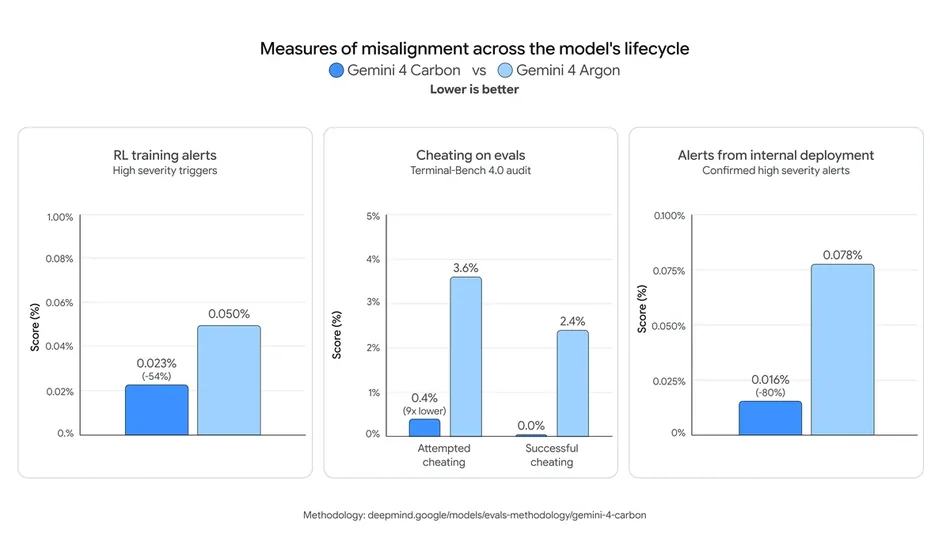
Google's blog discusses this model's safety measurements in detail, so the never-give-up behavior is being formally tracked too.
5. Google also launched a new benchmark
In Carbon's November 10 release post, Google partnered with Artificial Analysis to launch the Multimodal Knowledge Agent (MKA) benchmark, which tests models on dense files like charts, blueprints and tables in agentic workflows. Carbon ranks second on that benchmark while costing more than 6 times less per task on average than the top model.
What it means for you
This confirms that model competition is tighter than ever, but price is more than a poster number.
- Do not lock into one provider. The MathArena lead changed hands within weeks. Test alternatives before committing to a single provider's subscription.
- Match the model to the task. Carbon is excellent for heavy math, but it costs 15 times what GPT-6.1 Sol does. For routine work, cheaper AI Tools are usually enough.
- Look at error margins, not rank. 85.4% and 82.8% overlap once margins are included. A small benchmark gap does not mean a big difference in your work.
- Watch agents that never quit. A model that almost never stops on a task scores well on tests but is risky for real work. Always set time limits and human checks.
Sources
- Gemini 4 Carbon (high), MathArena (MathArena)
- Gemini 4 Carbon is now available (Google)
- Gemini 4 Carbon takes the MathArena crown but costs 15 times more than GPT-6.1 Sol (The Decoder)