
Anthropic launches Personal Finance, Claude can now read your bank accounts
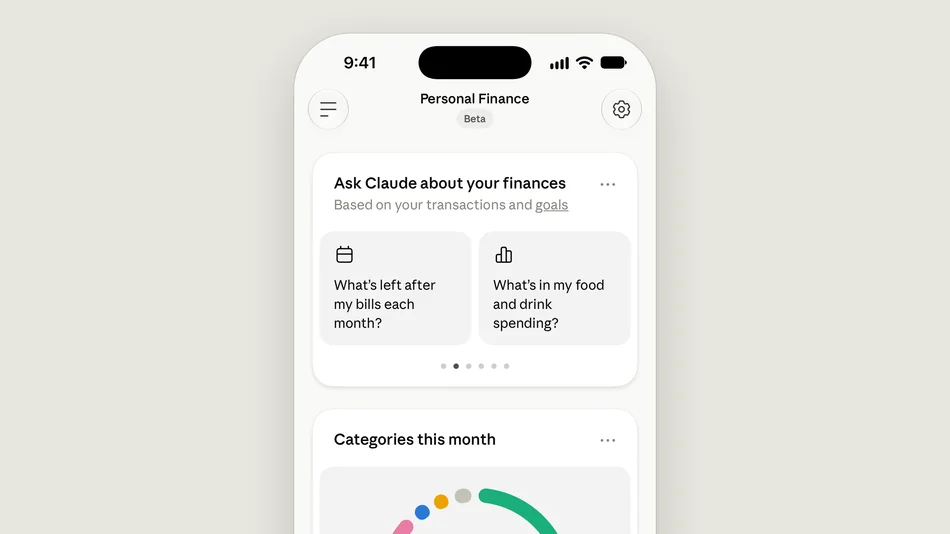
Anthropic has started rolling out Personal Finance in Claude, a beta feature that links your bank and credit card accounts to answer questions about your money.
Anthropic announced a new feature called Personal Finance in Claude on November 5, 2026. It lets you link your bank, credit card, loan, and investment accounts, then ask questions about your own money in plain language. The beta rollout starts this week, only for Pro, Max, and Ultra plans in the United States.
1. What Personal Finance does
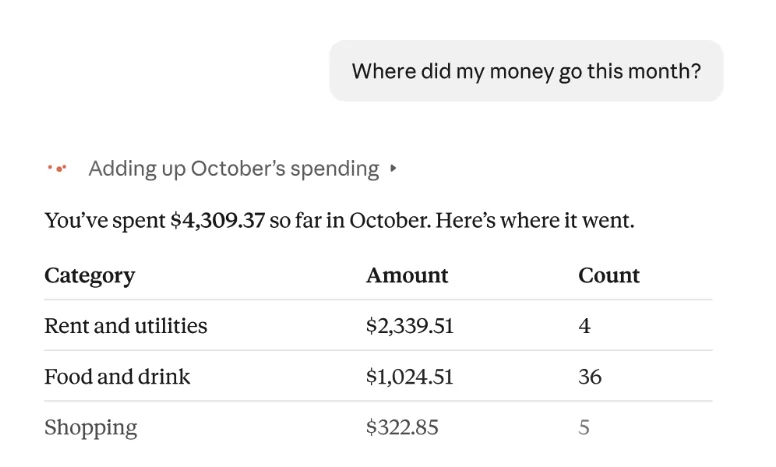
The feature answers money questions from the accounts you connect. Ask "Where did my money go this month?" and Claude adds up your spending across those accounts, sorted by category.
In Anthropic's official example, the total comes to $4,309.37, with more than half going to rent and utilities and $1,024.51 to food and drink. You can also ask for a weekly spending chart, a calendar of what's due, or a dashboard of the numbers you choose.
2. A real example from Anthropic's announcement
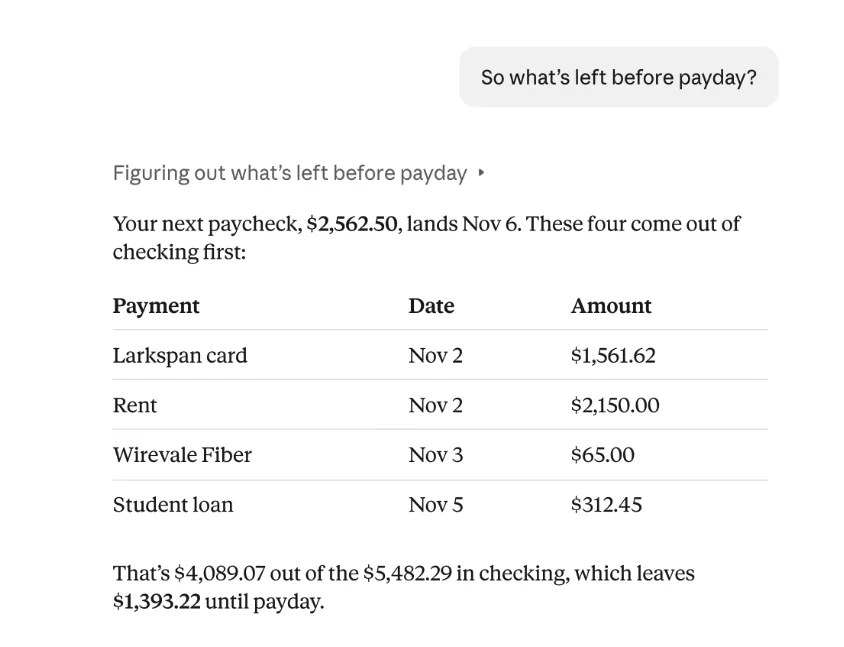
Anthropic walked through one scenario: it is late in the month and payday is still 10 days away. The user asks "So what's left before payday?" and Claude lists four payments coming out of checking, including $2,150.00 for rent.
After $4,089.07 in bills, Claude says what remains until payday is $1,393.22. Every figure comes from the transactions in the accounts you connected, not a generic estimate.
3. It also spots problems you would miss
Beyond summaries, Claude reads across every account you connected and can point to what is easy to miss: charges that hit twice, unexpected fees, or a bill that has crept up all year.
You can ask bigger questions like "Am I spending more than I make?" or "What's an APR, and what has mine cost me this year?" Claude explains the term, then adds up the interest you have been charged.
4. Security: read-only access through Plaid
Accounts connect through Plaid, a service that links apps to banks. You sign in to your bank yourself on Plaid, so Claude never sees or asks for your bank password.
Claude's access is read-only. It cannot move, manage, or invest your money, and it is not designed to give investment advice. For each account you choose to connect, Claude sees the bank's name, the account's name and type, the last four digits, balances and credit limits, and up to two years of transactions.
Anthropic also says conversations inside the Personal Finance hub are not used to train its models.
5. Claude plays catch-up with ChatGPT
TechCrunch reports that the launch positions Claude as a personal finance companion, and notes that Claude is playing catch-up: OpenAI introduced similar personal finance tools in May, also with account connections through a third party.
The difference Anthropic stresses: Personal Finance has no ads or sponsored recommendations, and it does not offer credit cards, loans, or savings accounts of its own. Anthropic says it is exploring how Claude can work alongside licensed professionals for bigger money decisions.
What it means for you
For now this is only for paying Anthropic users in the US, but it shows where the industry is heading: AI chatbots are becoming the place people handle daily work, including money.
- Check your plan. This is Pro, Max, and Ultra in the US only. Users outside the US cannot use it yet, so do not subscribe just for this.
- Be careful with bank data. Even with read-only access through Plaid, think before connecting your accounts to any AI.
- Verify important figures with your bank. Anthropic itself admits Claude can make mistakes; ask it to show the transactions behind each number.
- Compare with ChatGPT. OpenAI has had a similar feature since May. If you use both, see which gives clearer answers for your own data.
Sources
- Introducing Personal Finance in Claude (Anthropic)
- Claude can now analyze your spending with its new Personal Finance tool (TechCrunch)
- Release notes (Claude Help Center)