Alibaba launches Qwen4-Max, a 2.4-trillion-parameter model with cheaper API prices
Alibaba released Qwen4-Max on November 16, 2026 with a 1-million-token context window and $1.50 per million input tokens, half its previous price.
Alibaba officially released Qwen4-Max on November 16, 2026, after a limited preview that began on November 11. The new flagship uses a mixture-of-experts architecture with 2.4 trillion total parameters and activates only about 71 billion per token. It reads text, images and video inside a context window of up to 1 million tokens. The model is live on QwenCloud through the Token Plan and API, plus QwenWork and QwenStudio.
1. What is new in Qwen4-Max
The Qwen4 architecture upgrades the earlier MoE design across attention, residual connections and embeddings. Where Qwen3.8-Max activated about 95 billion parameters per token, Qwen4-Max activates about 71 billion, 25% fewer at the same 2.4-trillion scale. In plain terms: more capability at lower inference cost.
The model is also built for long-running work. In a next-generation chip cooling test, the Qwen team ran a Qwen4 agent for a continuous 48 hours through four iterations of a closed-loop workflow to discover an experimentally validated coolant molecule. In an Alzheimer's research experiment, the model executed 454 tool calls and 3,239 metric evaluations to design 24 candidate molecules.
2. Prices fall by half
The new list price is $1.50 per 1 million input tokens and $4.50 per 1 million output tokens, down from $2 and $6. Implicit cache hits cost $0.075 per million tokens. For comparison, Anthropic lists Claude Opus 5.5 at $20 per million output tokens.
Real cost per task fell further. The numbers differ by report: the Qwen announcement put it at $1.67 for Qwen4-Max versus $4.43 for Qwen3.8-Max, a 62% reduction. TechNode reported RMB 26.58 falling to RMB 11.16, about 58%. The official Alibaba blog said "around 60%". All three cite the same Work360 benchmark, so the exact figure depends on whose math you follow.
3. Benchmark performance
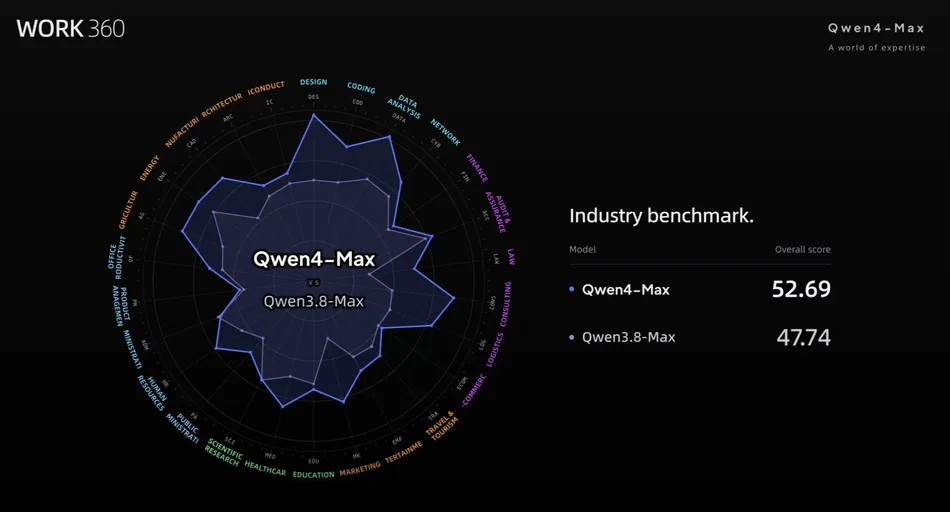
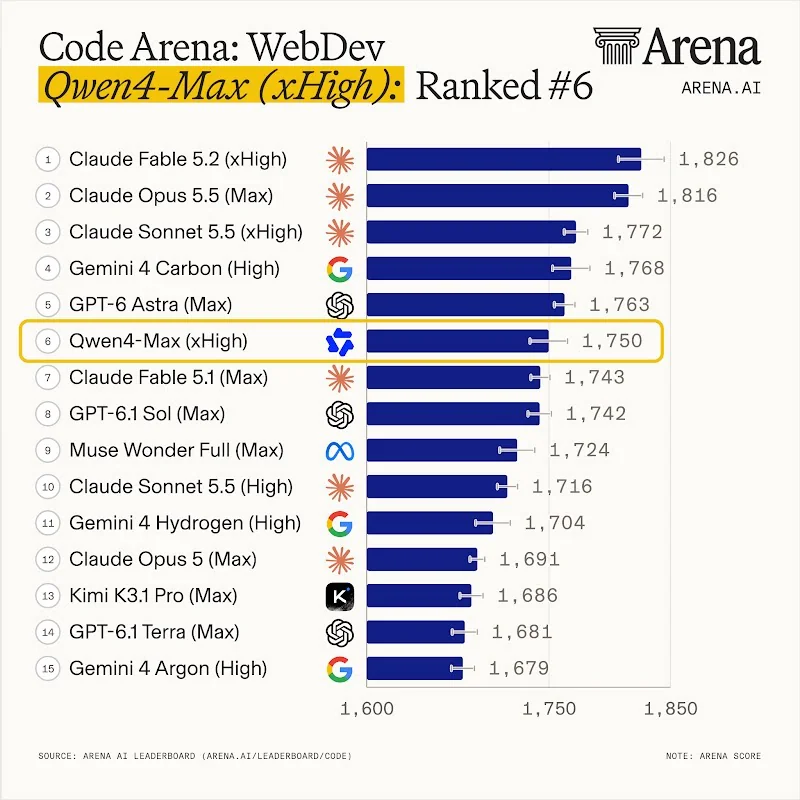
According to Work360, Alibaba's internal benchmark covering industry tasks across 721 specialized fields, Qwen4-Max outperforms Qwen3.8-Max overall while using 35% fewer tokens in High effort reasoning mode. On Code Arena, a real-world coding leaderboard, the model ranked 6th.
In an automotive manufacturing demonstration, Alibaba said Qwen4-Max cut manual workpiece programming time from roughly 475 minutes to 24 minutes, a 95% reduction, using feedback-driven iteration that caught machining errors before the machine started.
4. Safety: promises not yet tested outside
Alibaba said cybersecurity training data is filtered by task intent: defensive material such as vulnerability verification and remediation is kept, while offensive attack content is removed. Code security checks during training lifted the share of functions passing both functionality and security tests on Last Secure Code Bench from 22% to 31.8%.
Analysts urge caution. Sanchit Vir Gogia of Greyhound Research said the cost figures are a vendor benchmark, not an assured reduction in a buyer's own spending, and that the safety filter should be tested by government evaluators or an outside red team. Yash Kadakia of Security Brigade noted that offensive and defensive cybersecurity knowledge are largely the same knowledge, so training-data filtering is not easy to separate cleanly.
5. What this means for developers
Qwen4-Max is closed-weight, but Alibaba plans to release smaller Qwen4 models with open weights, without a date. Developers will get a choice: a paid flagship for heavy work, or smaller open models for lower cost. The team also shipped a plugin that lets agents deliver an initial version of their work and revise it as users give feedback.
What it means for you
Price competition among AI models is heating up, and this round comes from China with numbers hard to ignore for anyone paying API bills each month.
- Prices are falling, not rising. $1.50 per million input tokens is half the previous price. If you build on APIs, revisit your cost estimates.
- Compare task costs, not token prices. The 58% to 62% figures come from Alibaba's own benchmark. Measure what 1,000 successful real tasks cost you, including human review.
- A 1-million-token context is no longer exclusive. Long documents, large codebases and video now fit in one context at a modest price.
- Wait for the open weights if budget is tight. Smaller open Qwen4 models are promised, good for testing before committing to the API.
- For enterprises, get independent security assessments before using the model on sensitive work, as the analysts cited by Computerworld recommend.